Lisbon, Bucharest, Tokyo, and Buenos Aires. In their books, Fernando Pessoa, Leopoldo Marechal, Mircea Cărtărescu, Haruki Murakami, and Leopold Federmair evoke places that are also characters in their works. They have a life of their own and pulsate alongside the humans that wander through them.
English Edition: Kathelijne Bonne
Tabla de contenidos
Lisbon, a setting for dreams
There is something both snobbish and beautiful about walking through cities with literature, I can’t quite grasp it. My wanderings feel less lonely, I could almost say I walked with Pessoa, with Borges, or with whoever. I hear myself and I wonder if this impression isn’t a bit vulgar, pathetic even.
Well, allow me to be a little vulgar. Because those are the thoughts I want to share today (others talk about travel, cooking, women, beauty clinics, or money).
In Fernando Pessoa’s walk in his Book of Disquiet , one perceives that the city of Lisbon is just another character in the story. I’m not going to repeat the stuff that has already been said about this work. Everything has already been written and there are plenty of reviews. I’m only interested in talking about the place the city occupies. Perhaps because the plot in these atypical works, as opposed to a classic work of fiction that deals with various actors unfolding on a stage, puts the stage in the center instead of the human characters. Through Pessoa’s wanderings through Lisbon, one’s desire to stroll through the city is awakened. Especially when she has to deal with the little anecdotes of everyday life. The city, the streets, and its neighbors pulsate alongside the main characters. I remember my walks through Lisbon with little Abril while her father pulled her stroller up the hills. I remember the tram. The views. The beautiful signs of decay.
That wonderful decadence can still be seen in some European cities but is disappearing in Spain. I also remember the parks, rice soups, chicken dishes. On that walk we visited Pessoa’s house. I hadn’t read anything by him yet, but it was a must-see. I’m not that much into visiting writers’ homes, but Lisbon invites to such frivolities. In stories, too, one tends to forget about the misfortunes of the tourist. Like the hills, the heat, the indigestion from eating too much. Literature always seems to beautify things.
A few days ago, a little story about a tobacco seller who dies and triggers a series of philosophical and humorous reflections in the narrator, went viral on X. These are the kind of minutiae that take on a different flavor under Pessoa’s gaze. Perhaps it is not Lisbon, but the author’s journey through those streets and the people he meets. This interweaving of poetry, philosophy, and chronicle places the city in fertile ground that only the author can create.
Bucharest, a dreamlike universe
My Romanian friend always tells me: don’t go to Romania! They’ll rob you. But even so, I still think it’s something I need to do in my life. We want to see those lively scenes we read so much about. There is something inviting about Solenoid by Mircea Cărtărescu, a novel to which I have dedicated two articles. His journey through the streets of Bucharest evokes not only an era, but a fantasy world that is only possible in the mind of the narrator.
It is wonderful to witness the adventures of this teacher who reminds us so much of the protagonist of The Book of Disquiet and the small characters who get swallowed up by the city, the system, the working world. (Once again, we find ourselves romanticizing a city that must be tough to live in. Once again, we walk into that foreignness that makes us adore things that are unpleasant to others. I can’t help but think of the decisions we have made in life because we believed they felt romantic!
Luckily, we have these wonderful authors that take the cities them out of their hiding places and make them grow. Solenoid lacks the humor of The Book of Disquiet. Except at the start : “I have lice again.” Anything related to lice makes me laugh a little.
Magical Buenos Aires
The walks in Lisbon and Bucharest obviously take me to Buenos Aires, another city that plays an important role in this league of city-characters.
And here I get more serious: because the genius of Leopoldo Marechal’s Adán Buenosayres lies not only in its poetic and dreamlike evocation of the city, but also in how vividly it treats the city as a playful subject. All this may sound unreal, until you arrive at the scene that is set in a library. It is nothing short of breathtaking. The whole book is so insane that I can’t stop marveling at the mind of the writer.
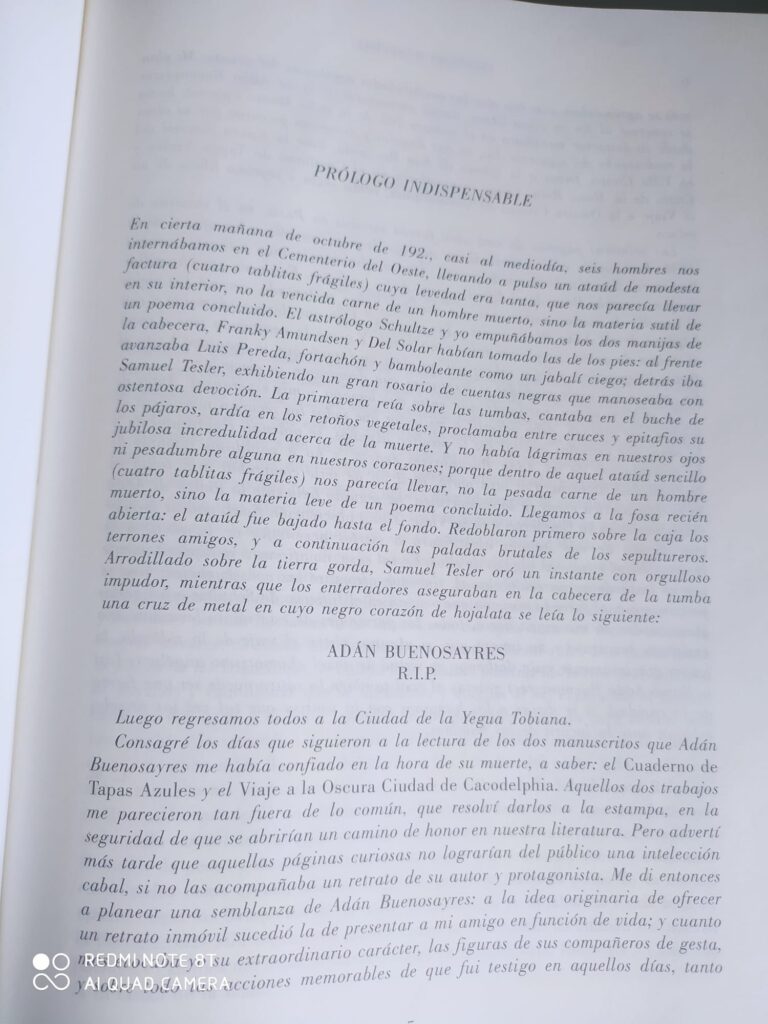
The beginning of Adan Buenosayres by Leopoldo Marechal.
I’m blown away by the beginning of that book. It is probably one of the best beginnings of any novel ever written. There is, at times, an almost cheerful tone that Solenoid misses. It always seems as if the narrator is laughing at us or at life (I feel this way with Stephen King and Mariana Enríquez, too). But there is added value: I have lived in Buenos Aires. How is it possible to walk around your own city, but in another time and space? It’s a bit like what happens when we live with family or friends. We’re in the same place, but in different dimensions, as if, in reality, we don’t really see each other. We recall the same events only to realize that our experiences are completely different.
That’s where literature begins.
The Tokyo of Murakami and Federmair
Now I live on the other side of the world, on an island in the Pacific. In Japan, too, people romanticize a lot, through art and culture, which ultimately shatter our expectations and play with our emotions. (How much damage has anime done to our deepest dreams?)
You adore this culture until you have to deal with Japanese bureaucracy or those godforsaken villages that are every bit as remote as Chacharramendi, Venado Tuerto, or Quequén. For God’s sake, is dinner really served at five pm? (Whenever I leave the city and go to a Japanese village, the first thing I do is worry: Who the hell will feed me? What and where will I eat? Why doesn’t anyone tell us how things work?).
And on that note, as soon as I arrived in Tokyo, I read Murakami’s Tokyo Blues, a book that left me feeling unfulfilled. Some parts moved me, but I got lost in all the cultural name dropping.
Nevertheless, living in Tokyo is amazing, as is reading about other people’s walks. It is paradoxical, because we walk alone or in groups, but the wandering is different for each person. My kids are older now, and sometimes we wander aimlessly or take the subway and get off at a random stop. That’s how we’ve discovered beautiful places, like the fishing pier on the river I described in A pause in Tokyo. There is something special about walking with children who stop at things you wouldn’t even notice or force you to look at the city in a different way (I am obviously forgetting their nagging or the way they jerk you around to make you see things, their slow or fast walking; you forget that again and again. Forgetting is indeed a form of survival).
But walking alone is a luxury that very few people can afford in a city as big and important as Tokyo. Especially if you are a woman. I highly recommend you do so. I must admit that Tokyo is the best city in the world to get lost in.
And for walks around this city, I always recommend Tokyo by Leopold Federmair. I buy it as a gift for friends and family too.
It is a stroll through everyday life and people’s neighborhoods. The author paints a picture of the different characters who are always somewhat shrouded in mist. In this book, Tokyo is more than just a beautiful setting to be seen and photographed. It is also a living being. There is a melancholic tone throughout the book. It is actually one of the most serious and darkest books I have ever mentioned. There are not many reasons to smile when reading it, except for one part where the author very subtly hints at his discomfort with Japanese society. It is a burst, a moment he seems to lose control in, but he quickly regains his composure.
And Tokyo is just there, alive and silent. Like The Buried Giant, Ishiguro Kazuo would say. A beautiful metaphor for dormant memory.
Japan does remind me a lot of that immense silence. And of places where reading the great authors makes you meet them and discover truths.
What cities and novels would you add to this list?

Deja una respuesta