Some reflections on the concept of friendship prompted by the experience of living in Japan, an eternal airport corridor where travelers and workers converge in a territory that belongs to neither time nor country.
English edition by: Kathelijne Bonne
Tabla de contenidos
Friendship in Japan
“We’ll leave without any friends,” my love tells me as we catch up on our respective summers or when we walk around and discuss things. Spain and Argentina, countries that are somewhat behind in certain respects, have some treasures: conversation, debate. The brushing of bodies and words. How little we rub against one another on this island of good manners and exquisite delicacy.
Japan is beautiful and brutal in equal measure.
“We’ll leave without any friends” is a phrase that sounds somewhat exaggerated, and perhaps it is. But I’ll try to qualify it: We will leave without those friends who brush against us, whose lives, smells, miseries, or affection seep quietly into our own. (of course, there are exceptions, so no one should take offense).
What is the substance of friendship? Words or aromas. A friend is always a mystery. Marina Garcés, the philosopher, writes in her latest book, The Passion of Strangers: A Philosophy of Friendship, about this concept, or the community of strangers, that having friends entails.
“Friendship relationships are the only stable forms of social interaction for which we have not invented an institution of our own.[1] This realization contains a question: why? The point of arrival, if one looks at the index , has a key word: solitude. Or two: invention and solitude. It also contains a question: what relationship is there between the two? Between the point of departure and the point of arrival lies a hypothesis: the passion of strangers.”[2]
I don’t know if I’m good at keeping friends, but I need them because family is not enough and, since they are my community of strangers, I need them to be very different from me. I do it from a place of solitude because I am a solitary friend, and I don’t like toxic or overly clingy friendships.
The Chimera of Searching for Authenticity
To get to Japan, I pass through various airports, lights, and shops that look the same all over the world because aspirational consumption is similar everywhere. Wealth homogenizes cultural patterns; one culture becomes dominant and the rest comply by following those patterns. There is a kind of obedience among the privileged who consume what we call culture.
Among the middle and lower classes, we see a different cultural substratum. It is what we cannot access when we do not speak Japanese. We draw closer. We try. We can observe. But we will never fully enter their Japanese lives, as Lafcadio Hearn reminds us so well. In these last few months, I have clung to those moments when our gazes cross—always evasive on their part, and mine inquisitive, perhaps ill-mannered, or passionate.
I no longer search for the essence of Japan. Japan is not about trying to recognize temples, learn ikebana, or understand its religion. All of that can be done from anywhere in the world. There is no such thing as an “approach to the Japanese reality” because there is no such thing as a Japanese reality.
There is only a gaze. One’s own gaze, from which we cannot escape. And it is as unintelligible as this distant and mysterious island.
Having said that, forming a bond of friendship with Japanese people is not easy, but if you overcome the language barrier, it is possible to build something around a hobby or activity. Is that friendship? It may be the closest thing you can aspire to, because it will be rare for them to invite you to their homes.
In Madrid, it is somewhat like that, but less so than in Japan. In Argentina, it is very common: people are always going to one another’s homes. I don’t know whether the concept of friendship plays an important role. I like the middle ground, which obviously does not exist. Going to people’s homes reveals a great deal about the other person. I don’t know if I want to expose myself in that way. I like people to come to my house and I feel they want to linger. It’s a lovely feeling, but in Japan it isn’t entirely relaxed. People arrive on time and leave on time. Everything is measured and little is spontaneous, even among foreigners.
Living in an Airport Corridor
“We’ll leave without any friends” because, in this endless coming and going of people, bonds do not take root. Conversations become subtle ways of finding out what you do or what your husband does, where you have traveled or with whom, what books you have published, or whom you know. Checking status in order to assess potential alliances, friends, or requests for favors. And realizing that, in this way of moving through the world, there are no hours and no places. Everything is unstable. Friends are a network, a means to an end. They are never the end in themselves.
Because Japan is living in an eternal airport corridor where one encounters an entire gallery of characters engaging in dubious, strange, somewhat bizarre behavior. People drinking whisky at eight in the morning or buying jewelry in the middle of the night because somewhere in the world it is a respectable hour, or taking a shower at the time when they should be sleeping, or eating ramen just after waking up from a long nap taken with the help of pills or melatonin.
And you contemplate that constant dislocation of time and space, where people are always coming and going because they are always escaping, or because what matters, as Rosario Bléfari used to say, is always happening somewhere else.
At the same time, airport life is the life of thousands of workers who move through the space at unusual hours. They do not travel, but they have to attend to travelers. They are foreigners too, but they have a different status. The Filipinos who clean in silence, the Southeast Asians who sing while doing their work, the Indians who always have a kind word, or those Brazilians who clean the airplane while listening to who-knows-what music through their headphones.
Their shifts begin at unusual hours, just like the flight I am on. An American supervises their work. The seat pockets must be clean, the vacuum cleaner must be run, the trash must be removed, meals and drinks brought on board, luggage loaded, the aircraft refueled. Getting an airplane moving requires a large number of people, and the chain of command is military in nature. The elegant women from the Emirates are trained to smile in the face of any mishap.
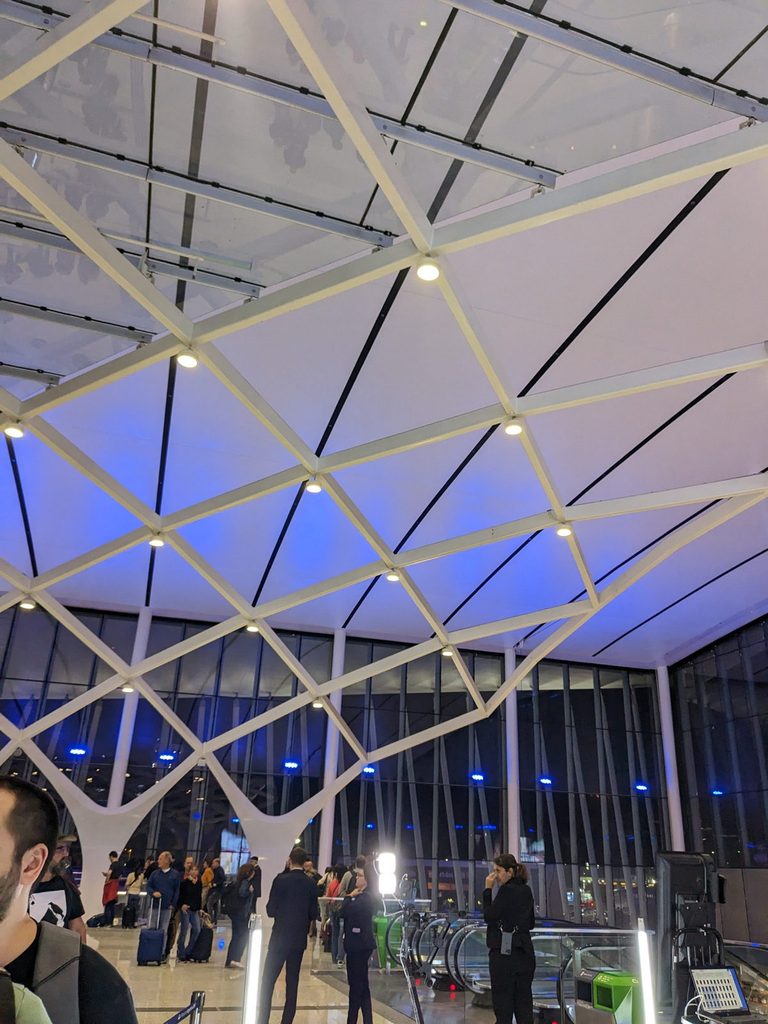
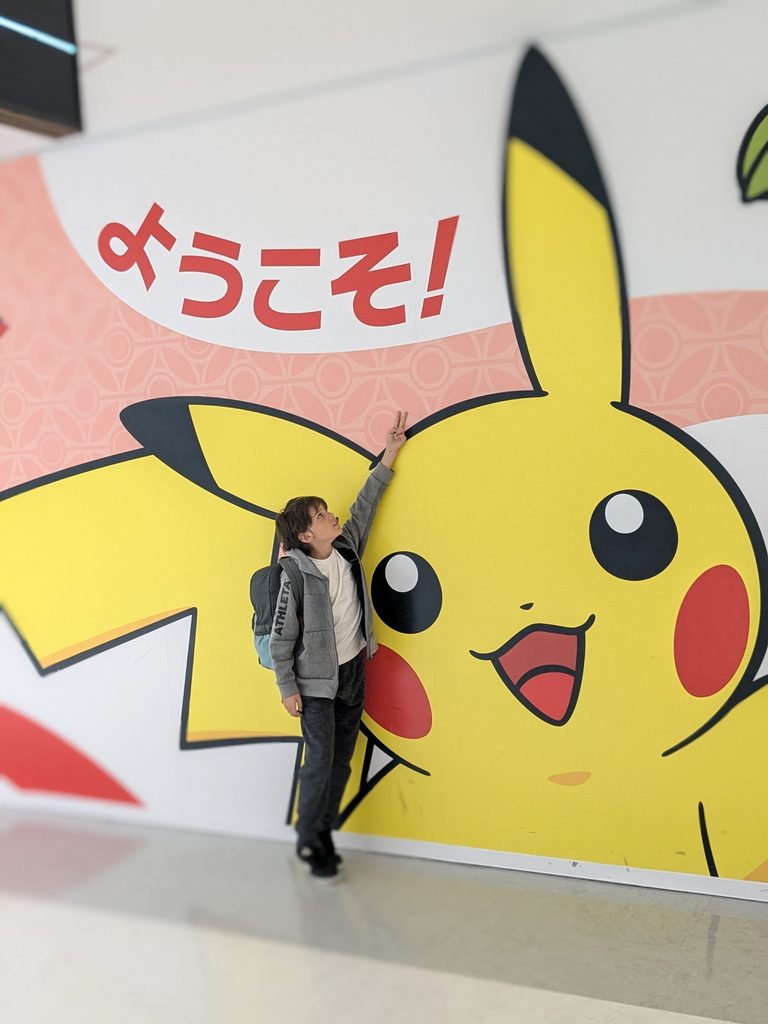
When I arrive in Japan, Hello Kitty or Pokémon greets me while reminding me of the rules. A rather unpleasant woman tells me not to stand still in the middle of the airport, but to keep moving. As soon as you scratch the surface a little, the smile disappears and something else emerges: the Asian darkness.
Japan is the airport corridor. I say this emphatically. A land of escapes, hierarchies, and mystery. I open my book of haiku and, as I walk, I wonder whether what I am reading is poetry or ultra-short stories. In reality, I don’t care. It seems to me that writing haiku is incompatible with a life surrounded by constant friends. The writing of haiku is the writing of solitary walkers who observe intently the details unfolding around them. Perhaps that is why I have begun writing them, and I dream of being able to put them into calligraphy.
Is friendship possible alongside the discovery of something small and grand? I have my doubts. Writing haiku requires a solitary and observant mind. In that sense, it should not surprise us that this genre was born in Japan.
I read Yosa Buson, who was a great painter and illustrated Matsuo Bashō’s The Narrow Road to the Deep North on his journey north.
With the wind pushing him,
an old man cut
grass in his garden.
I too have seen old women being blown away, and I spend my days watching people and animals. I also like observing insects, which are very strange, and people’s behavior, especially that of drunk people.
I only have a few months left. Soon I will return to Spain. Even so, I cherish the time I have. Because, as with everything, there are exceptions. There are still a few precious stones left to explore.
People and places that are waiting for me and that I carry in my heart. Friends? Perhaps.
I am waiting for them too.
Notes
[1] At the moment, a new book by Clémence Guetté, a member of the French National Assembly, is being published, titled Pour une politique de l’amitié, in which she proposes granting rights to this bond. I hope to read this book soon.
[2] Own translation based on Garcés, M. (2025). La pasión de los extraños: Una filosofía de la amistad. Galaxia Gutenberg.
[3] Own translation based on Buson, Yosa. En un sueño pintado. Satori, 2016 (p. 41)

Deja una respuesta