English edition: Kathelijne Bonne
I survived my first Mother’s Day in Japan. I can’t think of a better occasion to comment on the latest book of Helen Hester and Nick Srnicek, on the world of unpaid work: “A history of the home and the fight for free time”. Actually, rather than commenting, I share snippets of daily life as a mother and reflections triggered by the book. Have fun.
Tabla de contenidos
Mothers in Japan
My life as a mother has not really changed that much since I changed Madrid for Tokyo. But there is one significant issue that provides food for conversation: the cupboards in my kitchen are often empty.
Since I’m here, I’ve hardly cooked. It is a matter of logistics: life here is not designed for big groceries. It’s not practical to load, store, freeze, plan. All that is time consuming. It’s not efficient for this repetitive, daily work to be done individually. Helen Hester talks about communal cooking. I like the idea. It’s much cheaper and more efficient to have someone cooking for several people. It’s the idea behind bentos and menu food houses. One rarely makes sushi at home on a day-to-day basis. Who has the time? Some moms ask me what I give my kid for a snack. Some do get up early to cook their children’s bentos. Obviously, I don’t meet any Asian or European standards of motherhood. I only cook my children’s dinners. The best thing about these self-sacrificing mothers’ comments is that they seem to be happy. In Latin countries it’s not that different, there is always some grandma around who cooks for everybody.
The concept of work under scrutiny
Of course, my young son hates it when I work. That is, me doing work that does NOT include cleaning, cooking, nursing or taking care of him, which is work too. He doesn’t mind that his dad does his job, but with his mom it is different. He knows that when I’m on the computer I’m only half present, and half in another world. I think he senses my freedom. I don’t blame him. He doesn’t consider the caring tasks as work, because of the love component. And that component is there, but it is mixed with ingredients of obligation and loss of freedom.
As for my daughter, I think she admires those chubby mothers with their typical mum haircut who bake cookies and cheer during soccer games of the kids. She also likes the moms who go to amusement parks, enjoy theme bars and take their daughters to get their nails done at a spa. What my daughter doesn’t know is that these mothers may read their daughters’ diaries, check their cell phones, or keep a close watch on their friends and what they discuss.
Sometimes she laughs and says that she’s born in the wrong family. I smile too. It’s not her fault she lives in the house of the empty cupboards.
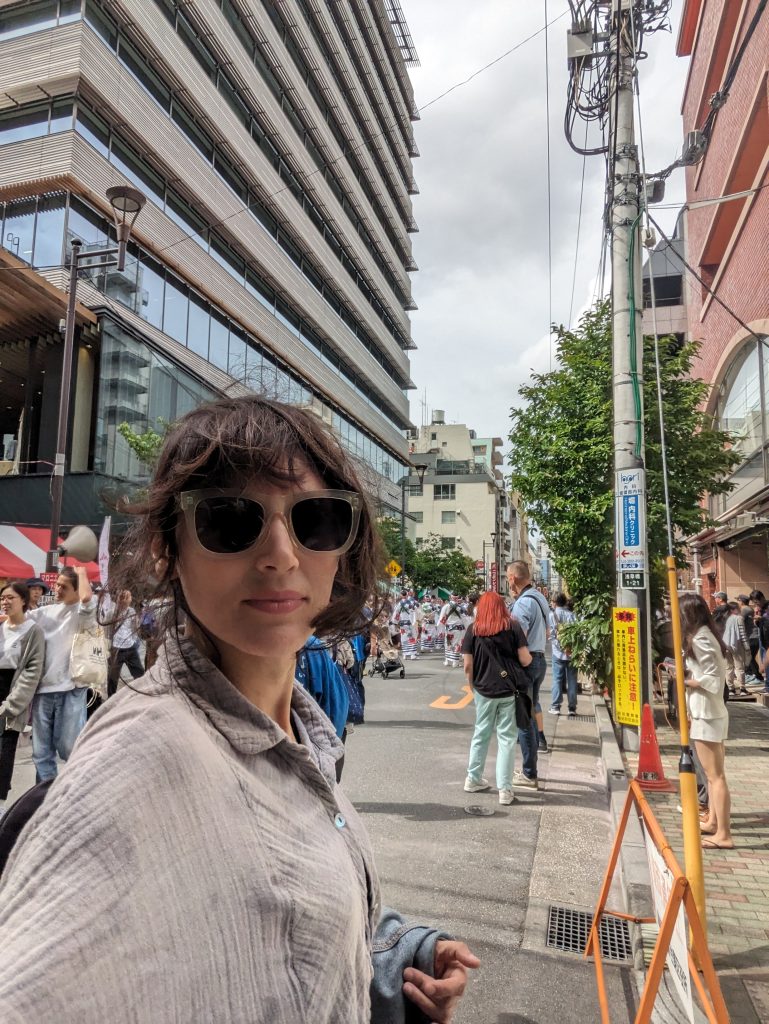
Mom, comb your hair, my daughter tells me. She longs for full cupboards, ‘girl scout’ cookies and visits to the cat cafe. She was born into the wrong family.
Mothers and fathers in Japan
In Japan fathers that take on caregiving roles are on the increase. It may be true in numbers, but it is still the mothers who leave their office jobs. It is them who are being suggested to not to go working outside of the home. He’ll take care of that.
I am amazed by the toilets in public places, by the facilities for breastfeeding, the gadgets, the backpacks for carrying babies. Everything seems to conspire to make motherhood comfortable (the Japanese are the kings of comfort).
Daycare centers are another place of collective care that are public and free. This is also mentioned in the book. It’s an example of places where services are produced which is more efficient if there is some economy of scale. However, I still see mothers picking up their kids, dressed in their long dark robes and wearing those little hats on their heads. I can’t help but notice how neatly dressed and pressed they appear when picking up their offspring. I marvel at such perfection. Helen Hester also talks about the increasing standards of cleanliness in homes. In Japan this is taken to the extreme. Technology at home is increasing but the number of hours spent on home tasks is not decreasing. The figures don’t lie. They, the mothers, are the custodians of cleanliness. They, the fathers, can’t take care of that, they have to work long hours in the office.
Sometimes I find myself getting caught up in discussions about the cleaning of things.
Nothing worries me less.
I think people who clean a lot are not happy. The reason is that there is no such thing as perfect cleanliness. The very concept itself is a defeat. Cleaning always ends in failure. If you think about it, all care tasks are an unresolved drama, which also comes up in the book. Tasks that never end. Like bureaucracy, hospitality. The unresolvedness of things. It is a subject that obsesses me.
On the other side of the story, there are paid jobs. Office workers are not necessarily more productive, but they are fortunate enough to earn a salary, and it turns out to be easy to measure their contribution. A mother who makes bentos, pick up the children, cleans, is of no interest to economists. They are invisible to the system. They don’t exist.
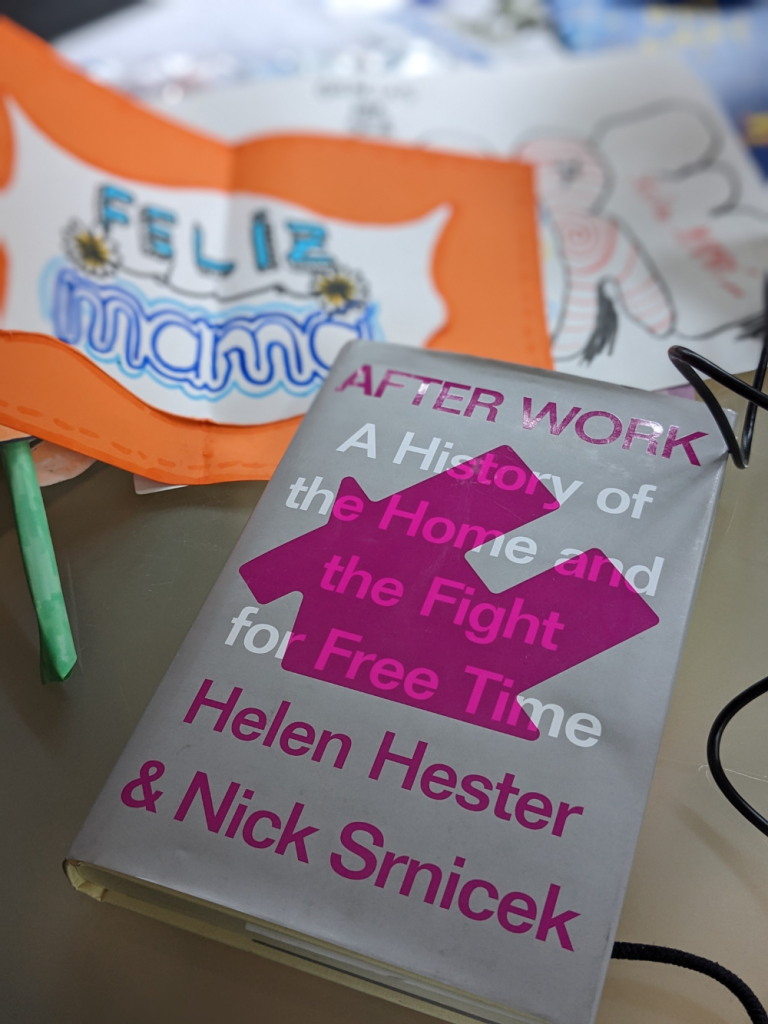
The best of the book are the footnotes, the bibliography and the index .
Not all spare time is the same
Just as there are different types of work, paid and unpaid, there are also different forms of spare time, depending on who does what. The authors know too well what they are talking about: they have just become parents. The spare time of a caregiver is different. There are interruptions and a lot of wasted moments, because the caregiver always keeps track of schedules, schools that finish, backpacks, sudden viruses. She can’t wander off too far because she can be summoned at any time. It’s like the doctor on call. You are a caregiver even in moments when you are not taking care because your main task is to be available. The authors note and measure the leisure time in different types of ‘jobs’. And even then, there are discrepancies. Like the mother who works while the children are in the background, or who spends her spare time with them in the background, is doing an economic activity that is not valued by the system.
They are caring, but for society it is called leisure.
Summer is never resolved
The end of the school year is approaching and just thinking about it makes me panic. It is an unsolvable issue because it repeats itself every year and it is exhausting. It’s not only the loss of routine, it’s the disproportionate consumption, the expenses, the disorder in general. I don’t see anything good in all this hopping around and even less with children. They seem less happy. They tell you they want holidays but in reality they are in a better mood during the school year. How can it be that they desire something that doesn’t make them happy at all? I’m puzzled by that mind game. I think they crave the idea of summer, whatever it entails. It is no different with adults.
You’re supposed to stop doing your job and turn to that other job that nobody wants to do. And don’t give me the “I love spending time with my kid”. It’s not about what we like or dislike. It’s about whether we recognize certain activities as work, or not. And whether society is prepared to recognize that work and close the existing inequality gap that haunts markets and families alike.
Once again, the authors remind us of what we already suspected: the jobs of the future will not be in programming, they will be in care: The fields with the greatest economic growth in the coming years will be: home care (at the top of the list), cooking and fast-food processing. It is precisely in Japan that one of the best growth sectors for immigrants is in the bentos-business. The authors have used data of the United States; it remains to be seen what will happen in other countries. Figures based on World Bank data show that care seems to be the only productive sector that continues to grow.
Many sectors will be automated, as we know, but there will be no shortage of jobs. The question is which jobs we will not run out of: caring for children, the elderly, cooking. The jobs that will not disappear will be those in which bodies do the work.
I already spoke some time ago about the absence of the body, not only from economic analyses but also from literature written by men. Virginia Woolf said:
One might read the lives of all the Cabinet Ministers since the accession of Queen Victoria without realizing that they had a body between them. To imagine any of the statues in Parliament Square running, climbing, or even in a state of nudity is not only impossible but also unseemly. The life, dignity, character of statesmen is centred in the head; the body is merely a stalk, smooth, black and inexpressive, whether attenuated or obese, at the end of which flowers a Gladstone, a Campbell-Bannerman, or a Chamberlain. p.218 (2)
Tasks done with the body require something more intangible, which a robot cannot supply. Is it affection? I don’t know. Is it experience? Years of culture that, like a backpack, weigh. Several studies in feminist economics have analyzed the reasons why some human beings do caregiving jobs. The cultural factor continues to be a determining factor.
As I write, I am preparing some truffles with my son, I am present. At least bodily. In my mind I am thinking about the article on the birth of the Red Sea that I am editing for GondwanaTalks. Apparently, I’m not doing anything prestigious. Truffles and care are nowhere to be found in the statistics.
I do nothing according to them. The satellite account goes silent .
I’m just there. That is also a job.
(1) Hester and Srnicek. A history of the home and the fight of free time. Verso. 2023 (in Spanish published by Caja negra).
(2) Woolf, Virginia. Books and portraits : some further selections from the literary and biographical writings of Virginia Woolf ; edited and with a pref. by Mary Lyon. New York : Harcourt Brace Jovanovich. 1981

Deja una respuesta