There are still spaces at the periphery of the market where the worth of things cannot be measured. What is the park worth? Or the temple or the library? That is what I am talking about today and how capitalist realism, as defined by Mark Fisher, seems to be the only alternative in Japan.
Spanish edition by: Kathelijne Bonne.
Tabla de contenidos
Spaces of consumption and spaces of freedom
In my trips around Tokyo, I’ve noticed there are two worlds, divided by the presence of tourism or by everyday life. I move away from the expat district because everything is homogenized there. I pass by Starbucks, Dean and DeLuca, the trees of the Meguro River. And along the way, the spaces of freedom are shrinking. The market is normative by nature. Everything is homogenized when we talk about money. When I studied economics, this was very important: to be able to give a numeric value to things. We measure to be able to consume and produce.
However, in the more private spheres where the market influences are diluted, it all gets confusing. Who does what in the household? That boundary between the chores is biased by love. And, if I do something with love, is it work? I have already talked about these things, but they are always remaining present and relevant. It is not by chance that the worlds of care and culture are always late in quantifying, naming and making visible. And it is no coincidence that such tasks and chores are mostly performed by women and are not very well paid. Feminist economics has been responsible for systematizing these debates.
In Japan I escape to other neighborhoods. And I explore some public spaces that do not require monetary consumption. In general, they are spaces of freedom and meeting places for different social classes, like the parks where my son plays soccer with kids from everywhere. They barely speak to each other, but they interact with a common language: the ball. I read and see how the trees change, there is a late flowering and in Tokyo it is nice to see the flowers bloom at any time of the year.
My Japanese classes are another space of freedom. There is no market, just volunteering and meeting people who are not there to consume. Again, it is the women who do the teaching. When I go to the library, I enjoy the silence. Access to culture does not require me to open my wallet. I too go there to study Japanese. No one tells me to leave if I don’t consume. I watch the people. In general, libraries in Tokyo are frequented by older people. Many read the newspaper, others can be seen writing. There is one thing that surprises me: the space dedicated to telephone directories. And I remember that when we were kids we used to read those lists and sometimes we would call a random person just for fun. Here too, the librarians are women.
Outside these spaces of NON-consumption, everything seems to be standardized: from Lindt chocolates, to Balenciaga clothes, to Starbucks drinks. Mark Fisher said that this capitalism reminded him of the Soviet Union. To consume is to become uniform. We go to the same places. We consume the same stuff. They play us with the rhetoric of words. We are sold individuality.
But, in reality, nothing is more collectivist than consumption.
Bureaucracy and capitalism in Japan
When I started reading Capitalist Realism, I did not know if its validity would remain intact. Sometimes books or ideas get old. However, it reminded me that some aspects of Japanese culture that seem intensified, especially its blending with American culture, like their love of protocols, the physical distance, the use of aesthetics for profit. The extremely procedural of relationships. The accountability, which is nothing more than the excessive elaboration of reports and handbooks. User manuals and instructions. Even the smallest aspect is regulated. It is the world of corporate hierarchies taken to all areas of social interaction.
The most perplexing of all this is that procedure and protocol take precedence over the relationship between people. The other day I arrived at a bar and sat down. I didn’t wait for anyone to clear my table. That seems to be a serious mistake. They made me get up. I am a customer, but it was very important to wait outside and not inside. But the table is empty, I thought. Even an act as trivial as going to eat is done following certain rules. A while ago I was thrown out of a restaurant for not speaking Japanese . I didn’t take offense. Because it’s all part of the same thing. If something falls beyond the regulation or protocol, for example the ways of interacting with foreigners, they prefer not to take any risks and choose certainty.
At my daughter’s school, where Anglo-Saxon culture reigns, everything seems to work through deadlines and handbooks. Even such elementary aspects as “pay attention to what your child says”, “turn off your cell phone in a meeting” are explained. Timings are millimetered in any type of meeting and nothing goes off script.
Mark Fisher has talked about the state of education in his time. He lived in the UK but most of his concerns applies to other countries. Especially in such crucial areas as health and education. Doctors don’t look you in the eye. They don’t tell you what you have. They just write prescriptions and seem annoyed by questions. They hide behind the screen and the charts. I was told there is budget problem, but isn’t there always a problem of money? I think there is more to it. Human care relationships are complex. Dealing with patients and students is cumbersome. Not to mention their parents. No one wants to endure the difficult parts of human contact because we are bodies with needs.
In such cases, the machine eliminates the problem. The protocol distances the bodies. It disconnects. It isolates. It avoids conflict. The problem is that it often does not solve problems, and more often, creates them. Of course, technology has given us many advantages that I too benefit from and I wouldn’t want to miss. But when we talk about fields like health and education, hospitality, sectors that have to do with caring for and treating people, to what extent are workers also losing freedom? Isn’t protocol a form of hierarchical control?
Running in Japan
It’s a wonderful feeling when I go out to run and I manage to escape from that immovable framing that the market forces me into. When I’m sweating and moving, and feeling free, the city becomes beautiful. No wonder there is such a love of running in Japan, you see old people running at all hours. “With the right shoes and a path that meets the minimum conditions, you can run as much and as often as you want,” says Murakami[2].
Tokyo more than fulfills this premise.
A woman can run in any neighborhood and there is no danger. Running is a form of freedom. And a way to escape from those rules that can be so cumbersome.
Fudo Mae is an area somewhat close to Meguro Station. There are alleys and stairs that lead to cemeteries. Tombstones coexist with townhouses. It is quiet and there are men at work. Gardeners remove weeds. There is a scent of flowers that is so subtle that it doesn’t seem real. And suddenly I come across some huge, leafy trees that remind me of my native gomero trees. (ficus)
There are weeds everywhere and through the swaying leaves I discover a large metal Buddha. Sunk in another dimension I find this hidden alcove. I walk the perimeter of this temple. I light some incense. Once again, these quiet and hidden temples in the middle of the city are places far removed from the market. Spaces to meet people, but also of solitude and silence.
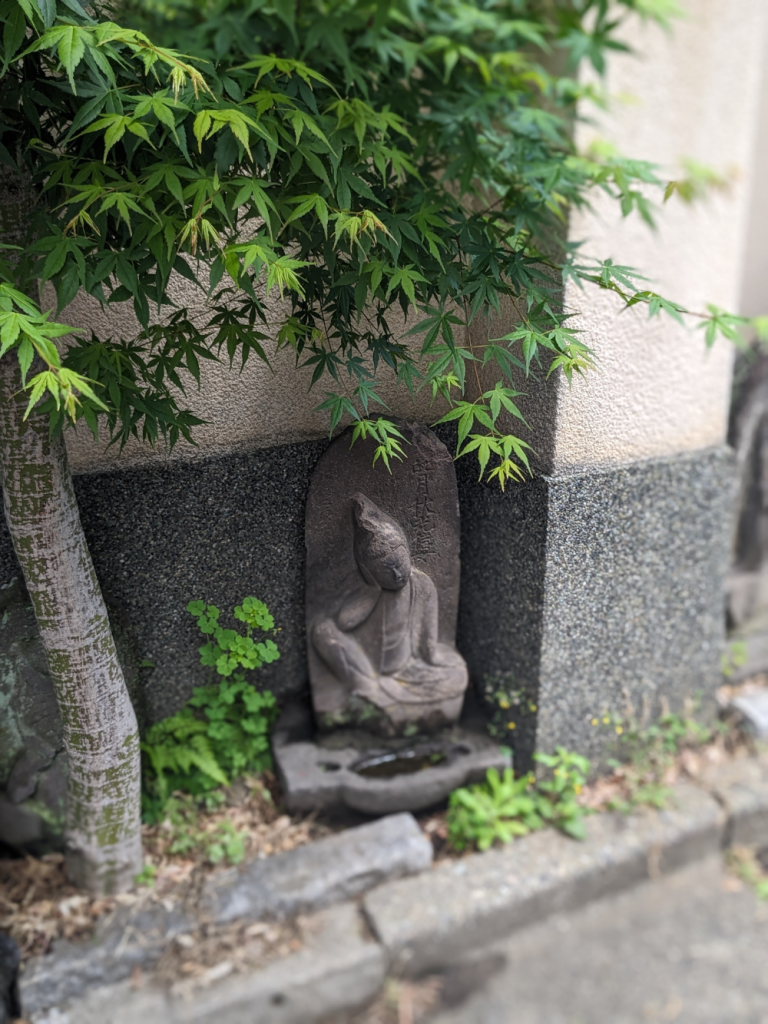
While running, you find beautiful corners.
About wanting things
In A utopia that ends with desire I’ve dwelled upon a key matter of things: a society without desire cannot exist.
We cannot imagine it and, in this lack of imagination, of which Fisher also talks, we must ask ourselves what place we want technology to play in the construction of a utopia. There is an underlying idea that makes me ponder:
And it is clear that this return would be possible only if one of two conditions is satisfied: a technosocial apocalypse or a return of authoritarianism. How else to dissolve the drive? And if primitivist equilibrium is not what we want, we would fundamentally have to be able to articulate what it is that we want, which would amount to disarticulating the core that capital forms with desire and consumer technology.[1]
Mark Fisher. Capitalist realism
In a way, it is telling me that the only two possible alternatives to this capitalist system are dictatorship or oblivion. Two scenarios that no one wants, at least on paper. However, I can’t conceive of a scenario of technological regression either.
This brings to mind Ishiguro Katsuo’s novel The Buried Giant, in which a people begin to lose their memory after a period of war. Is Japan on that path? Are we in Latin America or Europe trying out authoritarianism as the only answer to a better world?
Unfortunately, those who achieve power cannot think of utopias. Always in their little heads there is an idea of a return to the past. I don’t know what past they imagine. I prefer to imagine futures (which is also a way of dialoguing with the past).
But where are the youth, the artists, the thinkers? Or maybe the common people thinking? I know they are and that is the paradox. The need for freedom to create possible worlds necessarily goes hand in hand with staying away from power, from the spheres of influence.
So how do we do that?
[1] Fisher Mark. Capitalist realism, is there no alternative? Zero Books. 2009
[2] Murakami, Haruki. What I talk about when I talk about running. 1017. Vintage. 2009.
Read more
- We Will Leave Japan Without Friends
- Sick of Being Lucky: Being a Woman in Japan
- Notes on Hiroshima
- The whole truth about housewives and expats in Japan
- Cities in books

Deja una respuesta