As a result of a small incident in Ginza where a man did not let me sit down to eat for not speaking Japanese, I reflect and learn from a society that isn’t like any other.
Edited by Kathelijne Bonne.
Tabla de contenidos
Japan efficiency
A similar situation happens several days before. I am on the phone with a salesperson from the Internet provider. I am a potential customer. On the other end of the line there is someone from an unknown country. Sometimes he speaks English, sometimes an interpreter, also at an undefinable location, intervenes. We can’t agree on how I will get Internet. But it’s more than a lack of agreement, communication is simply impossible. We’ve been like this for weeks.
In Japan, small things quickly turn into big projects. It is said that Japanese society is very efficient and technological, but I still see public telephones and faxes. Which is beautiful. I heard that public administration is just now getting rid of floppy disks.
That being said, I have no doubt this society must somehow be very efficient. In university we studied its economic miracle ad nauseam. I remember Benjamin Coriat [1] lecturing about the Toyota method of production and its particular way of increasing productivity without resorting to economies of scale. This idea obsesses us all and has to do with producing a lot at the lowest possible cost. It’s what we all want, getting more while consuming less, with less time and less resources.
We’re going to great lengths to defy the laws of physics and economics, look for ways to create shortcuts and to cheat on them. We want more for less. That’s what economics, physics, chemistry, the ecosystem, animals, plants are all about.
But textbooks and industry stories aside, living where I do, one perceives that everyday life is designed to be efficient, that is, for the average Japanese person. The system requires that there are never any unforeseen events. That makes the language issue in this country fascinating.
When I went to sign up for Internet, I was asked to bring someone along who speaks Japanese. There was even a clear attempt not to offer the service. I can understand that they do not want to deal with someone who does not speak the language, even if it means losing a customer. It seems to me a very anti-capitalist form of protest to try to get rid of the customer, to ignore him or her. But the surprising thing was that they openly said that the reason was our inability of speaking Japanese. In another country you would be lied to, you’d be given strange reasons. But in Japan there is a tender honesty that soothes the otherwise brutal feeling of being excluded for being a foreigner. In the police station as well they asked if I could bring along a native speaker. If this request is made so often, it must mean that bringing a local to help you out is a rather common favor amongst friends. I don’t see myself capable of ever asking a friend to waste an entire morning to deal with any bureaucratic mess.
And for that matter, I don’t have any close friends in Japan yet. At least not close enough to ask to help me sorting out my paperwork.
And even if I had, who in their right mind would ever torture anyone like that? I think I was more surprised by that request than by the fact that speaking Japanese or not makes such a difference.
Speaking Japanese for lunch
I love getting lost amidst those half-retro Ginza buildings reminiscent of Galerias Santa Fe in Buenos Aires. Sometimes the best places are in the basements and on the top floors.
The elevator overlooked the street. And a sign showed that there was a restaurant on the fifth floor. I saw office workers coming in. Male faces not making eye contact. There are young gelled guys in half wrinkled, shiny suits. Aspiring to more. Whatever it is. Consumption. The promise of prosperity. I also see a couple, she looks like an Asian Snow White, with her doll-like hairdo, the bows, the dress, the spotlessness of the always-ironed attire. More men by themselves. I look at them because they are in an all-male group, although women can be seen alone and I like that. I got into that elevator too.
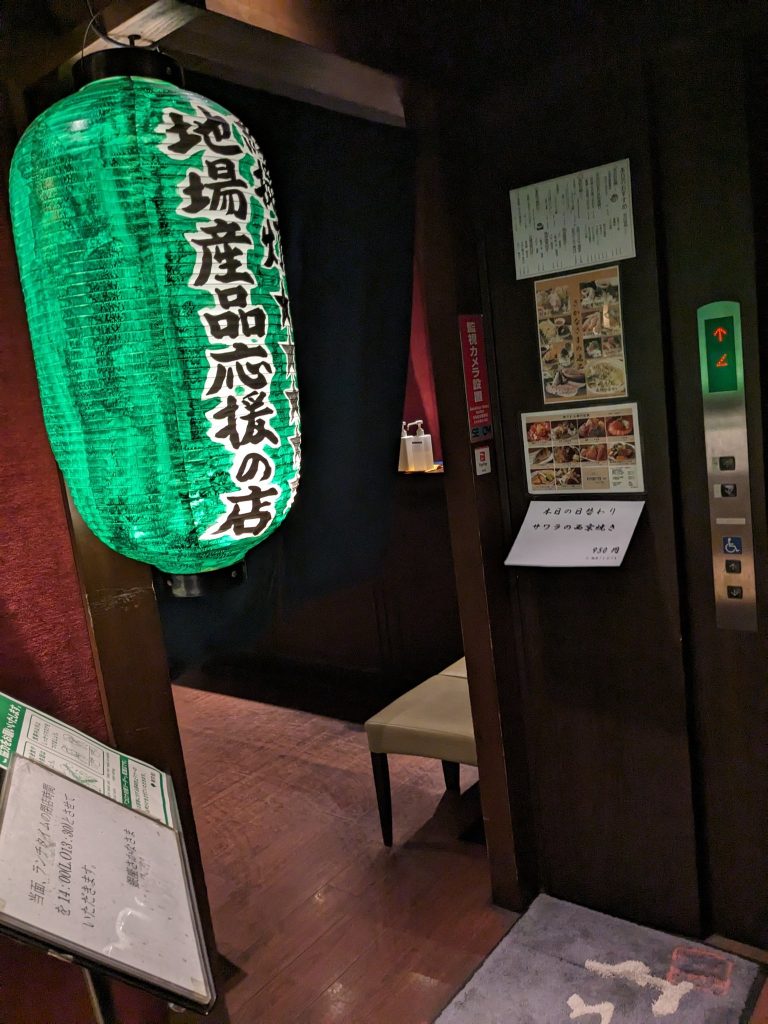
The entrance of the restaurant that kicked me out for not speaking Japanese.
A table for one must be easy, I thought. I’m flexible, I can sit at the bar, in a corner, I can stand. I don’t care. I’m greeted by a man in a suit and with wet hair look.
Do you speak Japanese?
I said no, then, the waiter gave me that very particular gesture with his arms that means no. So basically, he was politely inviting me to get lost.
Because the Japanese don’t say no. Borges tells the following anecdote:
“Maria Kodama told me that in Japanese you never say no; it would be a great discourtesy. If you ask: “Is the dictionary on the table?”, they answer: “Yes, the dictionary is not on the table”, which is equivalent to “Yes, you are right to doubt: the dictionary…” [2].
That doesn’t bother me. Saying NO is abrupt and unnecessary. They cross their arms and I understand that. But on the other hand, for eating, why would I need to speak Japanese?
I told him pointing at my cell phone that had the translator on, but he made an unfriendly face at me. I left, obviously, because I don’t want them to spit on my food.
Island thinking
I talk about these little experiences, not to ventilate bad feelings, but to help me investigate a society I want to know better.
We are an island, a Japanese woman tells me. The mentality of the islander is complex. We tend to forget it because Tokyo is so big that we don’t realize that we are far from the mainland. It’s an idea that doesn’t convince me because, deep down, I feel like I’m in Barrio Norte or Plaza de Castilla or in any area of a random city. There are sidewalks, there are cars, there are signs in English, there are Starbucks and KFC chicken.
I’m oblivious to being on an island.
One has the idea that the islandness has to do with the remote, the small, being either utopian or dystopian. In this case, it is different. I don’t feel remote or isolated at all.
I don’t feel the ocean around me. In Tokyo, we hardly see the sea.
However, I walk one block and I already see those little wooden houses. The rundown yet dignified tidy bikes, the flower pots, fishbowls, the brooms, the order. The little things.
There is something about this inwardness that attracts me. I like it. The silence. The people in flip-flops, in slippers, with furry hats, with their teddy bears. That cozy aesthetic that invites you to squeal all day long. People between their four walls, consuming whatever videos, music, books. It is baffling to see that contrast between the way the Japanese embrace American culture, and their great rejection of the English language.
I run into a Japanese guy I met at the Murakami event at Waseda University, he speaks Spanish reasonably well. He doesn’t speak English. I ask him why. It’s difficult, he tells me. The pronunciation form is complex for them. Not so with Spanish, which has more familiar sounds. They hate English because something about the order of the words is very difficult for them. But then American culture is amalgamized in a way that you don’t see in Spain or Argentina.
It is the cult of work, discipline, hierarchies, order. I think of those spheres of social order imposed by the market and companies. And Americans do feel at home here.
They have their spheres of consumption, their places, their culture.
The language must be the homeland and the childhood of a people who refuse to abandon their way of speaking. And yet another paradox: katakana is basically English written in Japanese (I’m oversimplifying). It’s funny how they refuse to learn English, but at the same time, they incorporate its words, Japanize them, bend them to their shape and form. It’s as if they grab them and crush them viciously.
I like the idea of making a mess with language.
Mold it to our liking. Perhaps it is a way to fight in a calm way, in a Japanese way, against this cultural bending. Hotto, engenier, coji. And I feel that, to make myself understood, I must go back to the most rudimentary.
Quiet forms for rebellion
Last small and complex task. My son’s goalball is broken. I think it is a nice challenge to try to change three rods. I have to get three rods, get them cut and have holes drilled in them. In Spain, an Uruguayan ironmonger helped me out. I was able to change three rods myself. Quite a feat. I thought that Japan was a powerhouse and must be able to handle this.
I drag the junk a few blocks, to find a dozed-off ironmonger in a tiny shop. Straw brooms occupy one side. There are kettles of all sizes on another shelf. The man looks like he has just emerged from a deep slumber. I explain my situation, he looks at me and says NO in a kind and polite way. There is no interest whatsoever. They know it’s not worth trying. It’s like a lack of strength. I understand. Maybe there is nothing to fight for and that is not necessarily bad. Maybe it’s even good and I’m facing an advanced society. The gentleman looks comfortable. I’m fine with him not getting out of his comfort zone. I am just an annoying foreigner who brings him trouble. Maybe an Argentinean or a Spaniard would have tried to get a few bucks out of me, give me little explanation, make a deal. He would have seen my tourist face and charge me double.
Here there is no desire for all that.
You see a lot of people asleep in Tokyo. Like the elderly couple selling the newspaper. People buy it and leave them the money. Nobody checks whether they pay or not. The elderly almost purr. Coins pile up on the counter.
Deep down, I like their attitude. And I think it’s a form of rebellion. An anti-capitalist way of seeing life. And the dozed-off gentleman surrounded by straw brooms reminds me of this poem by SHINKICHI TAKAHASHI[3].
ABSENCE
Just say,
«He’s out» –
back in five billion years!
[1] An exciting account of the Toyota method can be read in Coriat, Benjamin. Pensar al revés. Siglo XXI. 2000 (Spanish edition)
[2] Bioy Casares, Adolfo. Borges. Destino. 2006 Available online here. (Spanish edition)
[3] Shinkichi Takahashi. Zen poems of Shinkichi Takashi. University of Illinois. 1986

Muy bueno!!! como siempre!
¡Gracias Martina!